
On Being British, Sceptical… and Why Tony Robbins Is Right
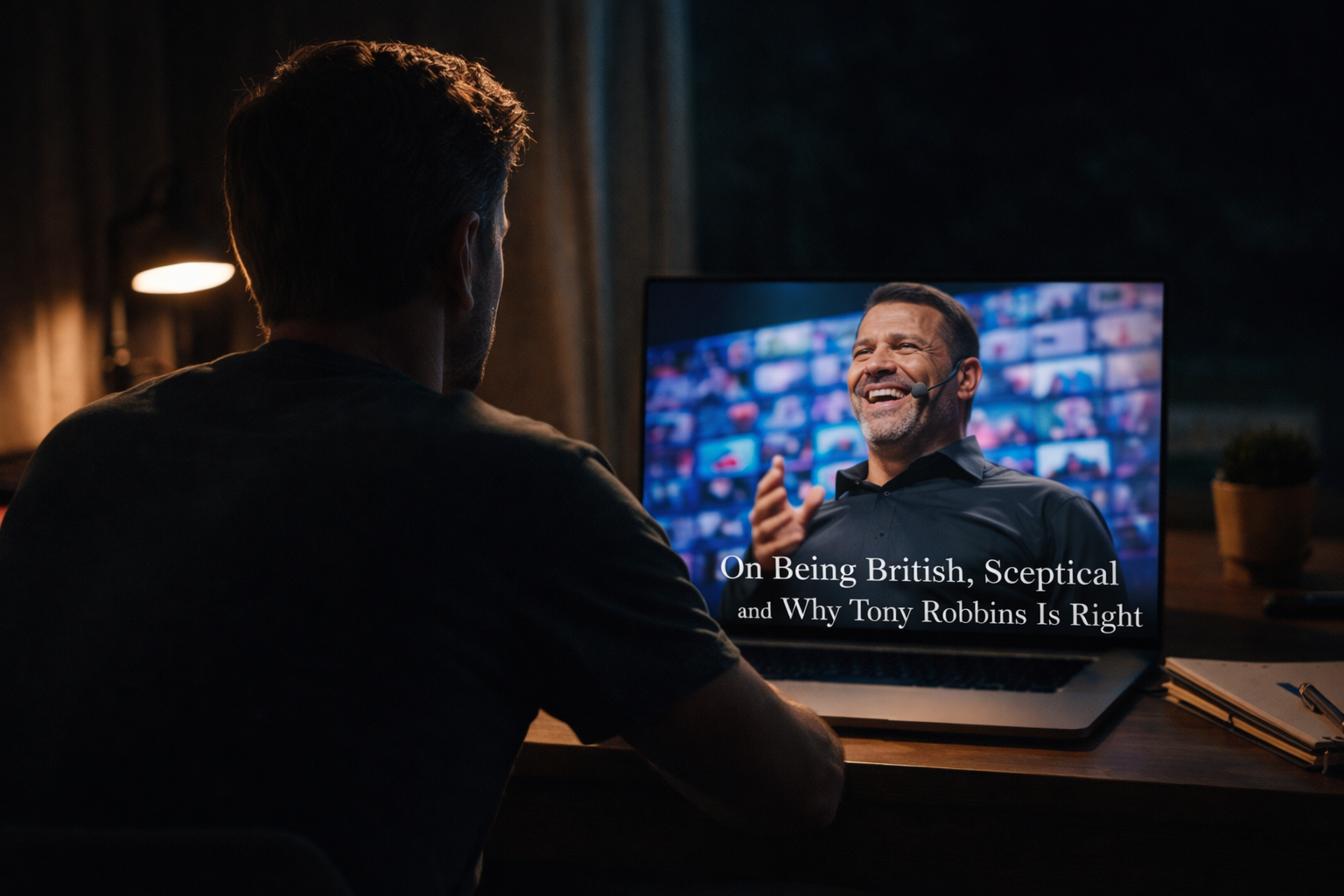
Stillness watching energy. State before story.
I attended a three-day Tony Robbins event last week without leaving my living room, which is not how I imagined my early fifties would unfold.
The catalyst was his recent appearance on Diary of a CEO. (Link to the interview here). What struck me was not the scale, the success, or the mythology, but the seriousness. Robbins came across as thoughtful, present, and disarmingly authentic. There was no sense of a man selling shortcuts. It felt more like someone still wrestling with the same questions, simply with more data than most.
So I did something slightly out of character. I gave up three consecutive evenings for three-hour online sessions with Tony Robbins.
As a Brit, this does not come naturally.
We are a nation that mistrusts exuberance. We admire success at a distance and interrogate it up close. When someone appears too energetic, too confident, or too pleased with themselves, our default response is to assume artifice. We raise an eyebrow, fold our arms and quietly pass judgement.
And while I brought some of that posture with me, my scepticism did not survive intact.
Not because the content was revolutionary. It was not. Robbins is not uncovering new laws of psychology or overturning centuries of philosophy. Much of what he teaches is well established. The link between physiology and psychology. The role of belief in behaviour. The danger of passivity. The power of attention.
What he does differently, and what many academics never manage, is translation. He takes ideas that often sit inert in books and gives them motion. He turns principle into practice.
This is precisely where critics tend to scoff. But accessibility is not intellectual betrayal. In many cases, it is intellectual responsibility.
I say this as someone who would once have scoffed.
Seven years ago, I was overweight, out of condition, and quietly resigned to decline. At forty-three, having never been physically fit as an adult, I decided to lose weight. Over six months I lost around twenty kilograms. What followed was not a health kick but a reordering.
I began running. Then running seriously. Then obsessively. I ran over a thousand miles in eight months as part of a Land’s End to John O’Groats challenge. I joined fitness classes. I played squash more intentionally. I lifted weights. Movement stopped being something I should do and became something I did.
This changed my life.
Not metaphorically. Practically.
My confidence shifted. My tolerance for discomfort increased. My appetite for risk grew. In the years that followed, I left secure employment to start a business. I travelled to the Democratic Republic of Congo and covertly entered an artisanal cobalt mine. I helped found a charity addressing child labour in global supply chains.
These were not the actions of a man merely thinking more positively. They were the actions of someone whose physical state had altered his psychological baseline.
This is why Robbins’ insistence that state precedes story now feels self-evident to me rather than theatrical. During the sessions, he repeatedly asked participants to stand, to move, to engage their bodies. Many did. I did not.
This was not resistance. Nor was it superiority. It was alignment.
I am already convinced of the truth he was trying to impart. Very few of his listeners will exercise as many hours per week as I do. Physical discipline is already woven into my life. I did not need prompting. I needed confirmation of my conviction that the physical precedes the psychological.
I say this carefully, because humility matters here. But I also believe something else, and I believe it strongly. The first gift God gave us was our bodies. If we cannot take responsibility for our physical stewardship, it is hard to argue we should be trusted with anything more abstract.
Robbins is not wrong to insist that transformation must begin in the body. He is right to do so unapologetically, even if it jars British sensibilities. Reality does not adjust itself to cultural preference.
One section of the event struck me in particular. Robbins spent time unpacking what he called sub personalities. The different internal voices that pull us in competing directions. The warrior. The magician. The king.
He did not reference Carl Jung, but the lineage was clear. More importantly, the explanation was lucid. He helped people see that inner conflict is not a character flaw but a structural issue. Transformation, he argued, requires integration rather than suppression.
This resonated deeply with my own experience.
I have long believed that compartmentalisation is one of the most dangerous things humans engage in. When we split our values, our behaviours, and our identities into sealed rooms, we may function for a time. But we do not flourish. Integrity is not moral perfection. It is internal coherence.
Robbins understands this, even if he expresses it in a different dialect.
British culture can be inclined to pride itself on scepticism, but scepticism without curiosity curdles into defensiveness. We tear down visible success as a way of insulating ourselves from risk. Yet our cynicism rarely wounds its target. It merely narrows our own field of possibility.
I attended all three sessions partly out of respect. Robbins had offered them freely. He had clearly invested immense energy.
Were parts of it jarring? Yes. Absolutely. But I am now convinced that much of that discomfort belongs not to him, but to us. Or at least to me.
I remain British. I remain reserved. I still flinch slightly when asked to stand up in my own home.
But I also know this. Nothing in my adult life changed until my physical state changed first. And nothing durable changed until my internal life became more integrated.
On those points, at least, Tony Robbins is not selling hype. He is naming reality.
And reality, whether we like the delivery or not, is always correct.
If this resonated with you, or you would like to discuss this further, you are welcome to email me: mark.preston@startbay.org