
The longer walk
Saying yes to things not yet understood, and the dog who walked with me.
Another video call, and I’m steady. I’ve usually read the situation, I have a sense of what to do, and I will probably say so plainly. That steadiness is real, earned over two years of coming to know the work well enough to be calm inside it. What the call doesn’t show is the cost of that calm, the part that comes afterwards, when the weight of having staked everything on my own judgement catches up with me.
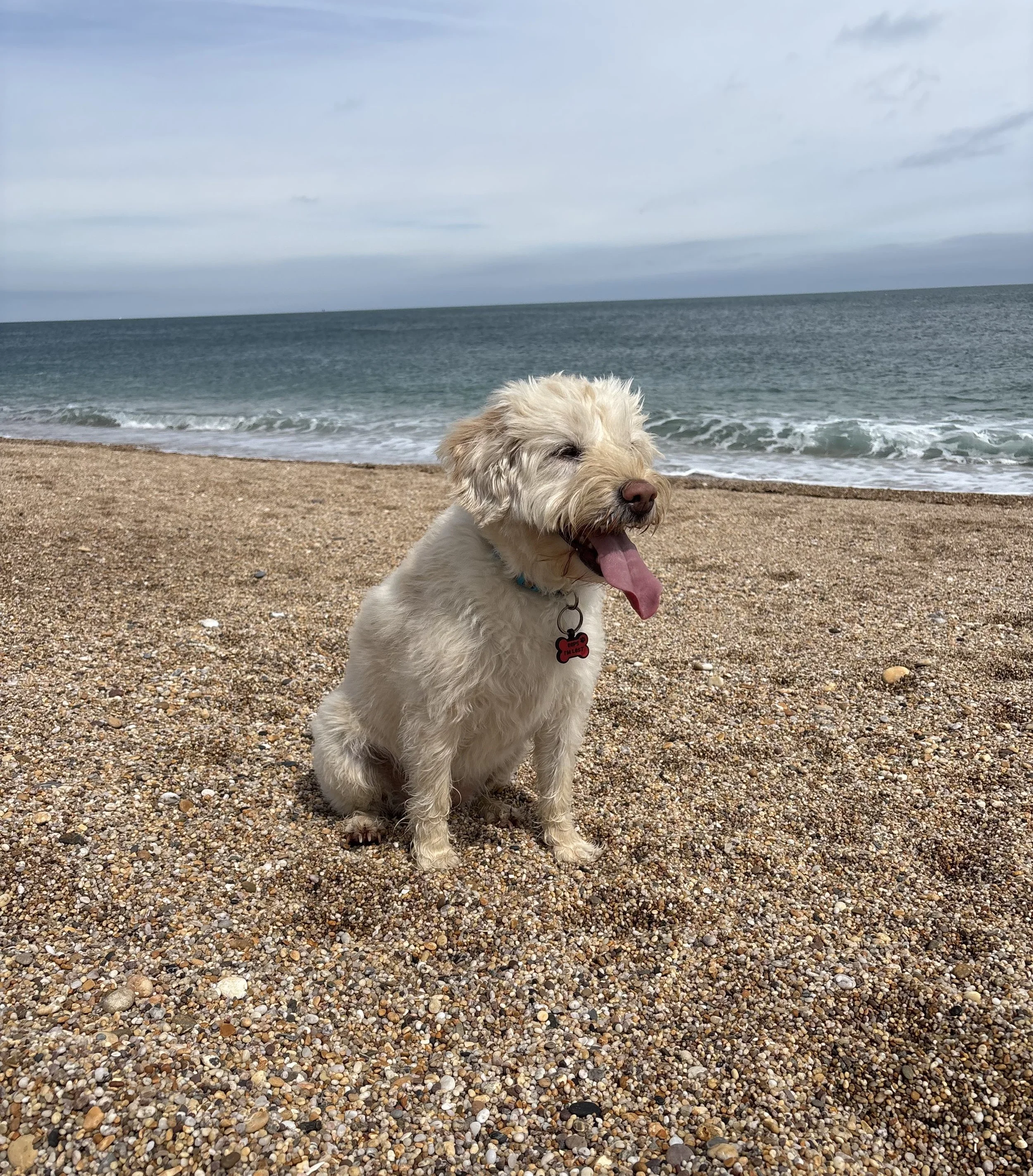
Poppy gets the worst of that, or maybe the best of it. When a call has gone badly, or a piece of work didn’t materialise, or I’ve spent an afternoon pondering a hard decision, she gets a longer walk than she strictly needs. We may walk further to the beach, the two of us, while the day settles in my mind. She asks nothing of me but the walk. On the hard days it’s the steadiest thing I have.
I read something recently that I’ve been mulling over: that the old line about nine in ten businesses failing is a kind of fallacy. It’s true the figure gets thrown around too freely. But I’d go further, in the other direction. Given long enough, every business ends, or changes hands, or quietly becomes something other than the thing it set out to be. Not nine in ten. All of them, mine included. Survival was never the measure, because nothing survives unchanged. Which is oddly freeing. It moves the real question away from whether my business, Start Bay, lasts forever and onto what the doing of it has already given me, and those it serves, whether it changes form sooner than I expect or runs for thirty years.
And the considered answer is that the things I value most from these two years came out of the positions I least wanted to be in.
Three years ago, while I was still drawing a salary, I said yes to a seat on the board of a large and rather historic charity. I remember the yes. It wasn’t strategic and I didn’t see any particular benefit coming my way. A recruitment firm had put my name forward, and I went along partly out of genuine interest and partly because I wanted to continue to learn and develop myself while doing some good. Initially I sat in those meetings wondering, privately, why I was there.
Then a chain of small things happened that started to make sense of the decision I had made. The founder of that recruitment firm became someone I have got to know a little better. The charity's chief executive resigned not long after I arrived, and the man who replaced him has turned out to be one of the finest people I know, someone I've had the privilege of supporting through changes that were large, overdue and hard. None of it was on any plan, because there was no plan. There was only a yes, given lightly, to a position I needed to grow into. And the last of those small things could yet be the most important. One of the trustees I sat alongside is now my business partner in a new venture, the kind of thing neither of us would have found in any other way.
That’s the thing nobody tells you about working for yourself, and it matters more than the money or the freedom or any of the self-promoting nonsense you see on an influencer’s Instagram account. A salary is one of the good things in life, and I promise, I don’t say that lightly. It’s steady, it’s kind to a family, and there’s a real relief in a predictable income that lands on the same day each month whatever sort of week you’ve had.
Nassim Taleb calls a salary one of the three most powerful addictions, alongside heroin and carbohydrates. The line makes me laugh because he’s right, and because I was the addict. I drew one for years and grew so used to the comfort of it. What the comfort conceals is its cost. It ties you to a chair, fills your days with someone else’s priorities, and calibrates your whole life to that monthly number, until you can no longer say yes to the unrepeatable thing when it wanders past.
You are never conscious of the cost, because you never see the doors you didn’t get to open.
There’s a line from Pink Floyd’s song, ‘Wish You Were Here’, that I have thought about for many years.
“Did you exchange a walk-on part in the war for a lead role in a cage?”
I used to hear it as a sad question about someone else. I hear it about myself now, and the wrong way round from how it tends to be meant. The cage in the song is the comfortable life. The good billing, the proper seat at the table, the salary that arrives whatever sort of week you’ve had, and the bars you stop noticing because they came wrapped in all that comfort. The walk-on part is the colder thing. Smaller, no lines, no lump sum dropping your account at the end of the month. But you’re out in the open where the weather is, where things actually happen.
I should be careful here, because it would be easy and untrue to turn this into a sermon against the salary. The reality is more nuanced than that. I took the board seat while I was still salaried, so the salary didn't stop me being open. What it would have stopped was where the openness led. A year or so later I stood inside an artisanal cobalt mine in the DRC, unauthorised, unprotected and crapping my pants, there to see for myself how the cobalt in every phone and battery is actually dug, by hand, by the people the supply chain would rather not look at. No employer on earth would have signed that trip off. A salary still lets you be the kind of person who says yes. It simply caps how far you're allowed to follow that yes. Take off the cap and the same disposition carries you somewhere you could never have drawn on a map.
I won’t pretend it has all paid in the way the word “paid” tends to suggest, and I’m wary of neatly tidying any of it into a success story, because the tidying would be the lie. There have been stretches when the business looked nothing like the thing I’d hoped for. I’ve sent invoices with a number on them that I believed in for about as long as it took to press send, and then sat with the conviction that I’d overcharged for the privilege of my own company. I still feel, more often than I’d admit at the village pub, the weight of being paid for nothing but my own judgement. Yet the sensible people I know, who have been doing this much longer than me, tell me I undercharge.
And yet the clients I believed I didn’t deserve came back. The work got done. The number on the invoice got paid, and then paid again. I’ve come round to thinking the doubt isn’t a sign that I’m bad at this. The ones you ought to worry about are the people who feel no doubt at all. The doubt is just the cost of taking the thing seriously, of caring whether you’ve earned the money rather than assuming it.
Perhaps most people, I think, shouldn’t do what I’ve done, and I mean that warmly. The uncertainty that makes the golden opportunities possible is the very same uncertainty that empties you out on a wet Tuesday and sends you up the lane with the dog. It definitely isn’t a lifestyle to be sold. For every yes that opened into a friendship, a venture, a mine in the Congo, there were a hundred that led nowhere, and you cannot tell, in the moment of saying yes, which is which. You only ever find out looking backwards.
That is what these two years have actually taught me, and it has remarkably little to do with business. Enduring uncertainty earns you nothing on its own, because the upside was never guaranteed. All it can do is keep you in the room where the upside might one day appear, and keep you there long enough, through the doubt and the empty Tuesdays, to still be standing in it if the thing finally arrives. The ones I most wanted to walk out of were the ones that gave me the most. I just couldn’t see it at the time. Nobody can.
Poppy is waiting by the door. The light’s going. Whatever becomes of the business, that much is already mine, and no failure rate, however you choose to count it, can take it back.